
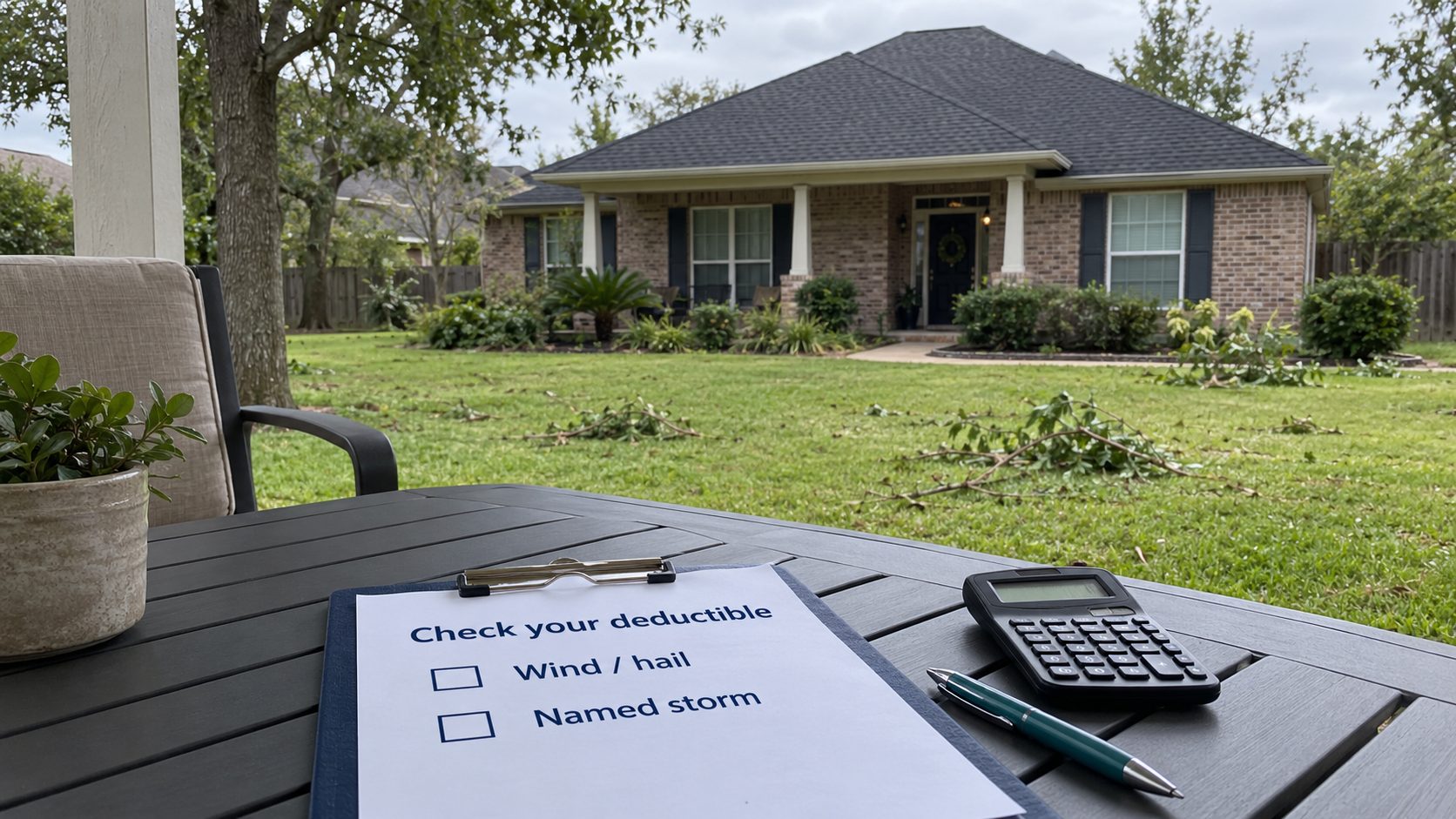
Two homeowners can have the same roof damage from the same kind of storm and pay very different amounts out of pocket. The difference is often the deductible: which one applies, and how it's calculated. Many people first notice this after a storm, when the claim check is smaller than they expected.
Here's how wind/hail and named-storm (or hurricane) deductibles usually work, how to find yours, and how to tell which one may apply to your claim. Every policy is different, so check your own declarations page and deductible forms.
The Storm Deductibles You May See
Many homeowners policies list more than one deductible:
- All-perils (or all other perils): often a flat dollar amount that applies to most covered losses, such as fire or theft.
- Wind/hail (or windstorm): a separate deductible that, as the Insurance Information Institute (Triple-I) puts it, applies "to any kind of wind damage." It may be a specific dollar amount or a percentage.
- Hurricane or named-storm: a separate deductible that applies only when a hurricane or named tropical storm causes the damage, usually a percentage.
Percentage vs. Flat Dollar Deductibles
A dollar deductible is simple: with a $500 deductible, Triple-I explains, "the policyholder must pay the first $500 of the claim out of pocket."
A percentage deductible works differently, and this is the part that surprises people most. It's calculated on the insured value of your home, your dwelling (Coverage A) limit, not on the amount of damage. Triple-I says percentage deductibles "typically vary from 1 percent of a home's insured value to 5 percent," and "in some coastal areas with high wind risk, hurricane deductibles may be higher."
The Math: An Example
Triple-I's example: "if a house is insured for $300,000 and has a 5 percent deductible, the first $15,000 of a claim must be paid out of the policyholder's pocket."
Now picture $10,000 of roof damage on that same home. With a $500 deductible, a covered claim would pay $9,500. With the 5% ($15,000) deductible, the damage is less than the deductible, so the policy would pay nothing for that loss. These are illustrative numbers. To find your own figure, multiply your Coverage A limit by your deductible percentage.
How to Read Your Declarations Page
Triple-I notes that "the details of hurricane deductibles are spelled out on the declarations page of homeowners policies." When you look at yours:
- Find every deductible listed, not just the first one.
- Check whether each one is a dollar amount or a percentage.
- Find your Coverage A (dwelling) limit and use it to convert any percentage to dollars.
- Look for any deductible endorsement or notice that explains what triggers the storm deductible.
Our guide to reading your declarations page shows where to find these terms.
Which Deductible Applies After a Storm?
The short answer: it depends on the storm and on your policy's wording.
- Wind or hail from an ordinary storm: if your policy has a wind/hail deductible, that may apply, since it covers wind damage from any source.
- A hurricane or named storm: the hurricane or named-storm deductible applies only when its trigger is met. Triple-I says triggers "vary by state and insurer and may apply when the National Weather Service (NWS) 'names' a tropical storm, declares a hurricane watch or warning or defines the hurricane's intensity."
- More than one could apply: the standard ISO HO-3 form says "only the highest deductible amount will apply." Endorsements and state forms vary.
Timing Windows
A named-storm or hurricane deductible usually covers a set window of time, not just the hours the storm is overhead. According to Triple-I, triggers "generally include a timing factor, i.e., damage occurring within 24 hours before the storm is named or a hurricane makes landfall up to as long as 72 hours after the hurricane is downgraded to a lesser storm or a hurricane watch cancelled." Your policy spells out its own window.
It also helps to know the calendar. The National Hurricane Center says, "The Atlantic hurricane season runs from June 1 to November 30."
Rules vary by state. For example, Triple-I reports that in Florida "the hurricane deductible applies only once during a hurricane season," and in Rhode Island the insurer "can apply the hurricane deductible only once" in a calendar year. Ask your insurer or state insurance department how the rules work where you live.
When the Damage Is Close to Your Deductible
Damage can turn out larger than it first looks, especially on a roof. Document it anyway, report it promptly, and consider having it reviewed before you decide. Our guide to documenting roof hail and wind damage can help.
Your Deductible Checklist
- On your declarations page, find every deductible: all-perils, wind/hail, named-storm or hurricane.
- Convert percentages to dollars using your Coverage A (dwelling) limit.
- Find out what triggers your named-storm or hurricane deductible and how long its time window lasts.
- Ask your insurer whether the storm deductible applies per storm or once per season or year.
- Keep receipts and proof you paid your deductible.
- Be wary of any contractor's offer to "cover" your deductible.
If your roof is part of the claim, our guide to ACV roof endorsements and roof schedules explains how your policy may pay for it.
When to Call a Public Adjuster
Consider getting help when:
- You're not sure which deductible the insurer applied, or why
- A named-storm deductible was applied to damage you believe happened outside the storm
- The insurer applied more than one deductible to a single storm
- Your claim was closed as "under the deductible" and you think the damage is larger
A public adjuster works for you, not the insurance company. We can review your deductible provisions, document the full scope of damage, and present the claim to your insurer. Results depend on your policy and the facts of your loss. Learn more about what a public adjuster does.
All Perils Consulting Inc. holds Texas Public Adjuster Firm License #3296354 and Louisiana Public Adjuster Firm License #1207216. In Mississippi, public adjusting services are provided under Barry Van Shoubrouek's individual Mississippi public adjuster license #10768959. The firm itself is not licensed in Mississippi.
Not sure which deductible came out of your claim? Call 877-5APC-247 (877-527-2247) or contact us. We can review your policy and talk through next steps with you.
Frequently Asked Questions
Is a 2% deductible 2% of my damage?
Usually not. Triple-I says percentage deductibles are "calculated as a specified percentage, for example 2 percent, of the insured value of the property." On a home insured for $300,000, 2% is $6,000.
What's the difference between a hurricane deductible and a wind/hail deductible?
Per Triple-I, hurricane deductibles "apply to damage solely from hurricanes," while windstorm or wind/hail deductibles "apply to any kind of wind damage."
When does a named-storm or hurricane deductible apply?
Only when your policy's trigger is met, such as the NWS naming a storm or issuing a hurricane watch or warning, and usually for a set window around the storm. Check your policy for the exact wording.
Can my roofer pay or waive my deductible?
Be cautious. Some states make it illegal for a contractor to waive or absorb your deductible without the insurer's consent. Ask your insurer before agreeing to anything, and verify the contractor's license.
All Perils Consulting Inc. is a licensed public adjusting firm. We are public adjusters, not attorneys, and this article is general information, not legal advice. Every claim and policy is different.
Free claim review
Questions about your claim?
Tell us what happened. A licensed public adjuster will look over your claim and policy and explain your options.
Get a free claim review