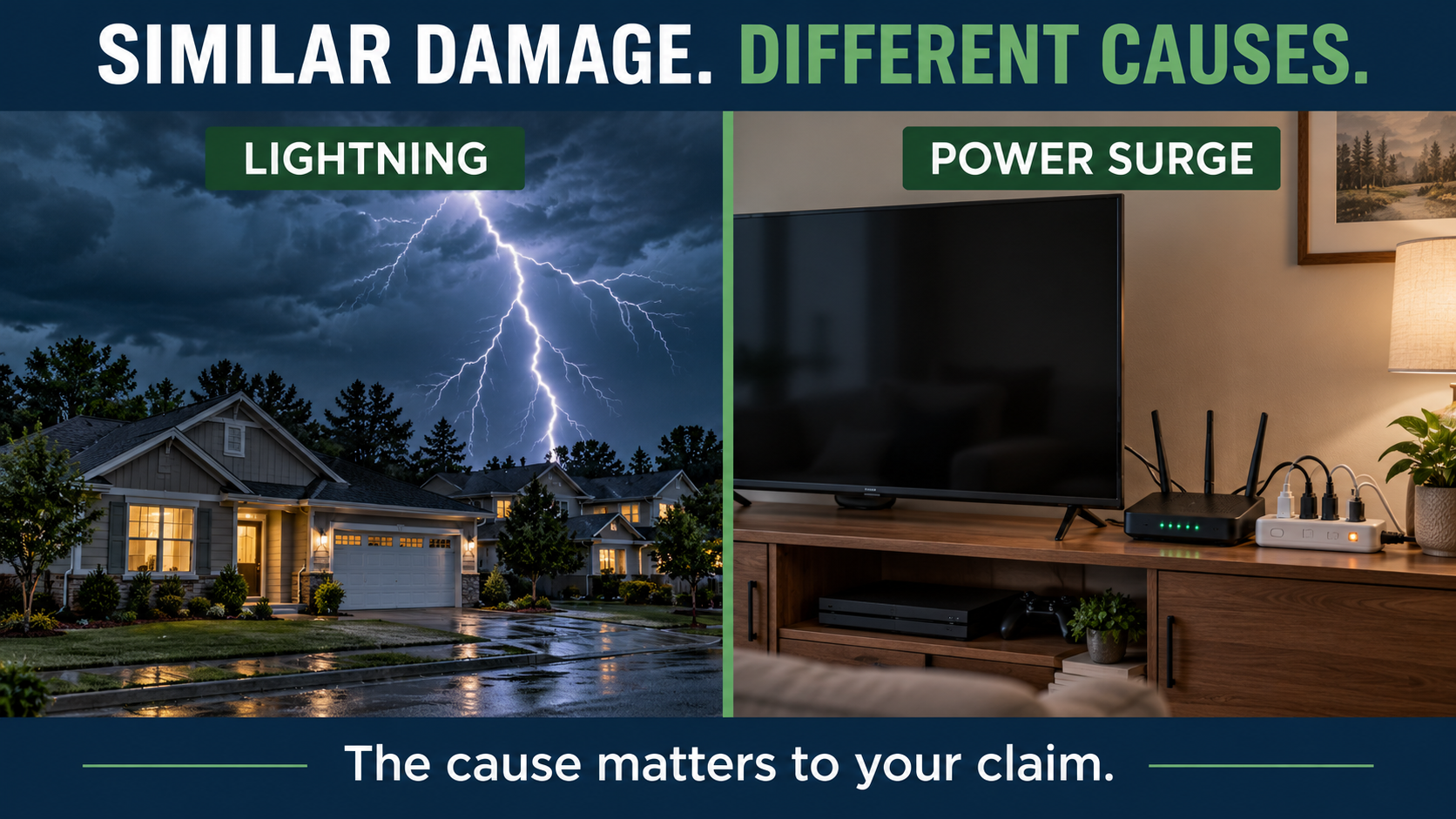
A thunderstorm rolls through. The lights flicker. A few days later the TV is dead, the HVAC board fails, or the garage door opener stops responding. The insurance question that follows is often the same: was this lightning, or a power surge from the utility — and does your policy treat those the same way?
On many homeowners policies, the answer is no. Lightning is usually a covered named peril. Damage from artificially generated electrical current (utility or man-made surge) is often a different peril, with tighter limits on electronics. This post explains how those paths typically differ, what evidence helps, and what to do first. Every policy is different, so your declarations page and coverage form control.
Lightning vs Power Surge: Why Cause Matters
Lightning is naturally generated atmospheric electricity. Direct strikes can leave scorch marks, damaged chimneys, split trees, or fire. Lightning can also enter through power, cable, phone, or data lines, or couple into systems without a dramatic burn pattern. If the cause is lightning, many policies treat resulting damage under the fire-or-lightning peril.
Power surge in everyday language often means a spike on the electrical system. On many ISO-style homeowners forms, damage from artificially generated electrical current is a separate named peril for personal property. Industry analyses of common form language describe a modern carve-out: that peril often does not cover tubes, transistors, electronic components, or circuitry in appliances, computers, and entertainment equipment — leaving, in practice, more of the housing or shell than the electronics inside. Built-in systems (such as central air) may be treated differently than freestanding electronics, depending on whether the loss is analyzed under dwelling or personal property and on your form edition.
A related idea is the power failure exclusion: many policies limit coverage when utility service fails off the residence premises, unless that failure results in a covered peril on the premises (for example, an ensuing fire). Carriers sometimes try to route outage-related claims into this language.
Rough industry guidance also draws a bright line: a surge from malfunctioning utility equipment or a short circuit is not lightning. Cause still has to be established.
Commercial property forms can be stricter than homeowners forms. Do not assume a homeowners analysis applies to a commercial policy.
What's Often Covered
Depending on your policy, lightning-related coverage may include:
- Dwelling and structures: damage and fire caused by lightning
- Building systems: wiring, panels, and fixed equipment damaged by a lightning-caused surge
- Personal property: electronics and appliances, when the cause fits a covered peril on your form
- Additional living expenses: if the home isn't livable during repairs
- Ensuing fire: see our guide to the first 48 hours after a house fire
Check your declarations for endorsements such as equipment breakdown or special personal property coverage. Those can change how electronics and surge losses are handled. Our declarations page guide shows where to look.
What's Often Limited or Excluded
Common friction points include:
- Artificially generated electrical current with an electronics/circuitry limitation
- Wear and tear or mechanical breakdown arguments when a single older device fails with no storm story
- Off-premises power failure language when the utility event happened away from the home
- Actual cash value on older electronics and appliances
- Sub-limits on certain categories of property
These are general patterns, not a substitute for reading your own policy.
Document Before Repairs
Quick steps protect both the property and the claim.
- Safety first. If you smell burning, see smoke, or suspect fire, leave and call 911. Do not restore power to damaged circuits until a licensed electrician says it is safe.
- Photograph before cleanup. Capture the electrical panel, tripped breakers, scorched outlets or wiring, the meter base, and any exterior signs near the strike path (trees, chimney, antenna).
- Unplug and preserve failed items. Keep damaged boards, surge protectors, and appliances until the claim is resolved. A surge protector that sacrificed itself can be useful evidence; it is not the same as proof of a direct strike.
- Get written technician findings. Ask an electrician or HVAC tech to state the failure mode in writing — transient overvoltage / surge / lightning overstress versus age or wear.
- Report the claim promptly, even if you do not yet know every failed device. Our step-by-step claim process guide covers what usually happens next.
Proof That Helps Establish Lightning
Carriers often ask whether lightning occurred near the property. Industry tools such as the National Lightning Detection Network and address-centered strike reports (sometimes ordered as products like STRIKEnet) are commonly used. Reports typically show stroke time, distance, and peak current within a search radius. Wrong dates or a radius that is too narrow can miss relevant strokes, so ask what window and radius the insurer used if they say "no lightning."
City-level weather history alone is weaker than strike data tied to your address and time. Neighbor outages and several devices of different ages failing in the same storm can support a sudden event story — but if no cloud-to-ground lightning was detected within several miles for the whole storm window, it is fair to reassess whether lightning is the right theory.
Hidden Damage That Shows Up Days Later
Control boards, smart devices, appliances, and garage-door electronics sometimes fail days or weeks after a storm. Latent electrical damage is a known pattern in forensic practice. That delay is exactly when carriers argue wear and tear or a "new" occurrence.
Help yourself by:
- Keeping a running list: item, circuit, last known working date, discovery date, and technician notes
- Asking the same tech to reference the storm date on later failures
- Supplementing the same claim in writing as items are confirmed, rather than opening a string of separate claims that look like unrelated wear
Texas, Louisiana, and Mississippi Notes
State insurance departments publish general claim guidance; none of the consumer materials we reviewed set a special lightning-versus-surge coverage rule. Process themes still matter:
- Texas: File promptly. TDI consumer materials describe acknowledgment and decision timelines after a first-party claim (including written denial explanations) and note that many policies have suit or filing deadlines — sometimes as short as one year unless good cause applies. Read your policy and calendar those dates.
- Louisiana: Statutes set claim-handling and payment clocks after satisfactory proof of loss, and many first-party property policies may not shorten the suit period below 24 months after the loss. Deadlines are fact-specific; a licensed public adjuster or attorney can help you apply them.
- Mississippi: Prompt-pay clocks are less clearly summarized for consumers than in Texas or Louisiana. Suit limitation is often set by the policy. Calendar the suit clause in your form and do not rely on informal timelines.
Licensing note: All Perils Consulting is licensed for public adjusting in Texas and Louisiana. Mississippi work is handled under an individual license at this time.
When to Call a Public Adjuster
Consider getting help when:
- The insurer says the loss was a utility surge, not lightning
- Electronics or HVAC were denied under an artificially generated current or wear-and-tear theory
- Multiple systems failed and the offer only covers part of the list
- You need help coordinating strike reports, electrician findings, and the scope of loss
A public adjuster works for you, not the insurance company. We review the policy language, organize the technical evidence of cause, document damaged systems and contents, and negotiate the claim. Learn more about what a public adjuster does and our public adjusting services.
Dealing with a lightning or surge claim? Call 877-5APC-247 (877-527-2247) or contact us. We can review your policy and the insurer's position with you.
Frequently Asked Questions
Does homeowners insurance cover a power surge if lightning didn't hit my house?
It depends on the cause and your form. Many policies cover surge damage tied to lightning. Surges characterized as artificially generated electrical current often face different (and tighter) treatment for electronics. Utility failure off the premises may also run into a power-failure exclusion unless another covered peril results on the property. Read the electrical and exclusion language in your policy.
What's the difference between lightning damage and a utility power surge on my claim?
Lightning is a natural peril. A utility or man-made surge is often analyzed under artificially generated electrical current or power-failure language. The same fried TV can be covered under one path and limited under the other. That is why cause evidence matters.
How do I prove lightning caused a failure when there's no burn mark?
Useful evidence typically includes strike or lightning-detection data for your address and time, a licensed electrician's written diagnosis, photos of the panel and any physical marks, retained failed parts, and a list of devices that failed in the same storm window. Lightning can damage electronics without a dramatic exterior burn.
My air conditioner board died a week after the storm. Is that still the same claim?
Possibly. Electrical damage can be latent. Report newly discovered damage promptly, get a technician note that ties the failure to the storm if supported, and supplement the existing claim in writing rather than treating it as an unrelated breakdown.
Will my insurer pay for fried electronics, or only wiring and built-ins?
It depends on the peril the carrier applies and whether the item is personal property or building property. Under some artificially generated current wording, freestanding electronics face a circuitry limitation, while built-in equipment may be analyzed differently. Lightning as the established cause is often the stronger path for electronics — when the evidence supports it.
Do I need a lightning strike report?
You may not order one yourself at the start, but carriers frequently rely on detection reports. Ask for a copy of any report they use, including the date range and search radius. Pair that with technician findings and your own photos.
All Perils Consulting Inc. is a licensed public adjusting firm. We are public adjusters, not attorneys, and this article is general information, not legal advice. Every claim and policy is different.
Free claim review
Questions about your claim?
Tell us what happened. A licensed public adjuster will look over your claim and policy and explain your options.
Get a free claim review